Wednesday, March 30, 2011
The Plot to Kill Jackie Robinson

Tuesday, March 15, 2011
Under the Dome
Eric Ambler Moves Us Even Closer to Evil
I like many things about this. First, I love that Ambler is moving us closer to evil; he takes someone from an ordered world and immerses him in the chaotic. As with Dimitrios, his protagonist is attempting not so much to impose order on the lawless world of war and crime - for then this would be a more standard police novel - but simply to understand it, to describe it, to give it the option of revealing itself. This makes these novels as much about character as plot, about plumbing the depths of a human heart involved in political machinations and consequences - the stuff of first rate spy fiction.
Second, his protagonist, the attorney George Cary, I described as "not extraordinary." He's not, but he's also not a wimp or a patsy, nor simply a device to reveal his opposite. Cary is in fact a survivor of World War II like so many 1950s men, an aviator. But Ambler makes the analogy that while Cary has always experienced danger and destruction, it was from far away, from the safety - comparative safety - of a bomber. He clearly draws the distinction between one who flies, Cary, and one who jumps from an airplane into the thick of things, his prey, Franz. He holds these up to us as juxtapositions so that evil can be more clearly illuminated. My point is by making Cary as complex a character as Franz, Ambler sidesteps a silly convention.
Last, there's a major female character as well, Maria, George's interpreter, that hides all of her characteristics and at which the reader's brain picks like a loose tooth. She surprises in the end with troubling implications. The truth is, I'm not sure what to do with what Ambler's given me there - Maria succumbs to evil and despises herself for it; is it because her life has punished her and twisted her so that she can only worship strength? Her humanity is one of the concealed casualties of war and politics and again we should be grateful that Ambler shines his light on it, however grotesque. Didn't see that aspect of the ending coming and was sort of disgusted when it came. Regardless, more Ambler in my future.
Thursday, February 3, 2011
Missed It By That Much

2nd Manassas is a somewhat overlooked battle in the American Civil War. That is a shame, because it provides a compelling drama in the brilliance of General Lee’s leadership, contrasted sharply with the utter incompetence of General Pope on the Union Side. This richly detailed account gets deep into the weeds of regimental level troop movements, but does so in a way that maintains a focus on the fact that these are real live people fighting and dying on the battlefield.
I never really understood 2nd Manassas prior to the book. It doesn’t have that one majestic battle that is associated with the more famous Civil War events. Instead, it is comprised of clashes set over several days. Lee just misses the chance to destroy the Union Army here. It is amazing how often the survival of either the Union or CSA armies in this war came down to a matter of just a few minutes. Both sides missed numerous chances to end this war years before the final surrender at Appomattox. A delay of less than 1 hour by Jackson on the final day may have cost Lee a chance to pin the Union Army in, and destroy it. Who knows what the US would be like today if that had happened.
Even though this campaign is a resounding victory for Lee, it is a victory at a steep cost. The losses and attrition resulting from the battle, and the march through Manassas to Maryland, would severely impact Lee’s ability to achieve victory at Antietam later in the fall.
Sunday, January 23, 2011
The Forever War

A 1974 book about an inter-stellar war that goes on forever, with an enemy we don’t understand, fought by soldiers that were drafted, and led by officers that are idiots. Vietnam anybody? Anybody?
This parable of the follies of war is as relevant today as it was in 1974. By taking the never ending war to a ridiculous extreme and by applying the paradox of near light speed travel to the protagonist, we get a hero who lives through the entire 1000 year war, while only aging a few years himself. The difficulties of integrating back into a culture that has gone through several generations while you aged two years also lets Hadleman say something about shell-shocked Vets that volunteered to go back to 'Nam 2 or 3 times.
Tea Party sympathizers, if they can even get through an anti-war novel, will recoil in horror and how humanity solves its war problem. Everybody should read this book though, especially those that won’t get it.
Tuesday, January 4, 2011
You know what I never used to like that I like now?
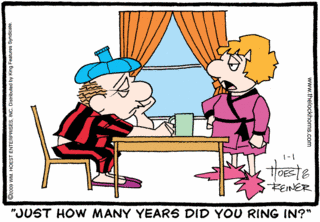
 The Lockhorns. When I was young I was horrified by this comic strip. Now that I am older and have been married a while I find the whole thing a lark. I mean it's obviously satire to me. Maybe because the characters are such caricatures of married people, I can look at the whole distortion and laugh. Even Wikipedia's description is funny:
-Leroy Lockhorn - The man of the house who drinks a lot, plays golf too much and chases everything good-looking in a skirt.
-Loretta Lockhorn - The woman of the house is a shopaholic, who drives terribly and does most of the handiwork around the house because either Leroy is too lazy to do it, or because he feels she should earn all the money she spends.
-Loretta's Mother - Never named and rarely seen (usually only during the Christmas season when she comes to stay), but hated mercilessly by Leroy.
-Marriage Counselor - Whom Leroy and Loretta routinely see but to no avail.
-Arthur the Bartender - Local saloonkeeper to whom Leroy often bemoans his circumstances.

Wednesday, December 22, 2010
The Fredericksburg Campaign: Winter War on the Rappahannock by Frank O'Reilly

This is the definitive book on The Battle of Fredericksburg. Incredibly detailed, exhaustively researched, and vivid in its description of the horrors of war. In a lot of ways, it’s the ultimate anti-war book. I can’t imagine reading this and thinking the carnage is cool. Although it delves deep into the minutia of troop level movements and battle strategy, Frank’s writing style keeps you completely engaged, and his extensive use of directly quoted accounts from the participants brings a real humanity to this 150 year old battle. Also, if you are ever in Fredericksburg and have the opportunity to take a tour of the battlefields led by Frank, don’t skip the chance.